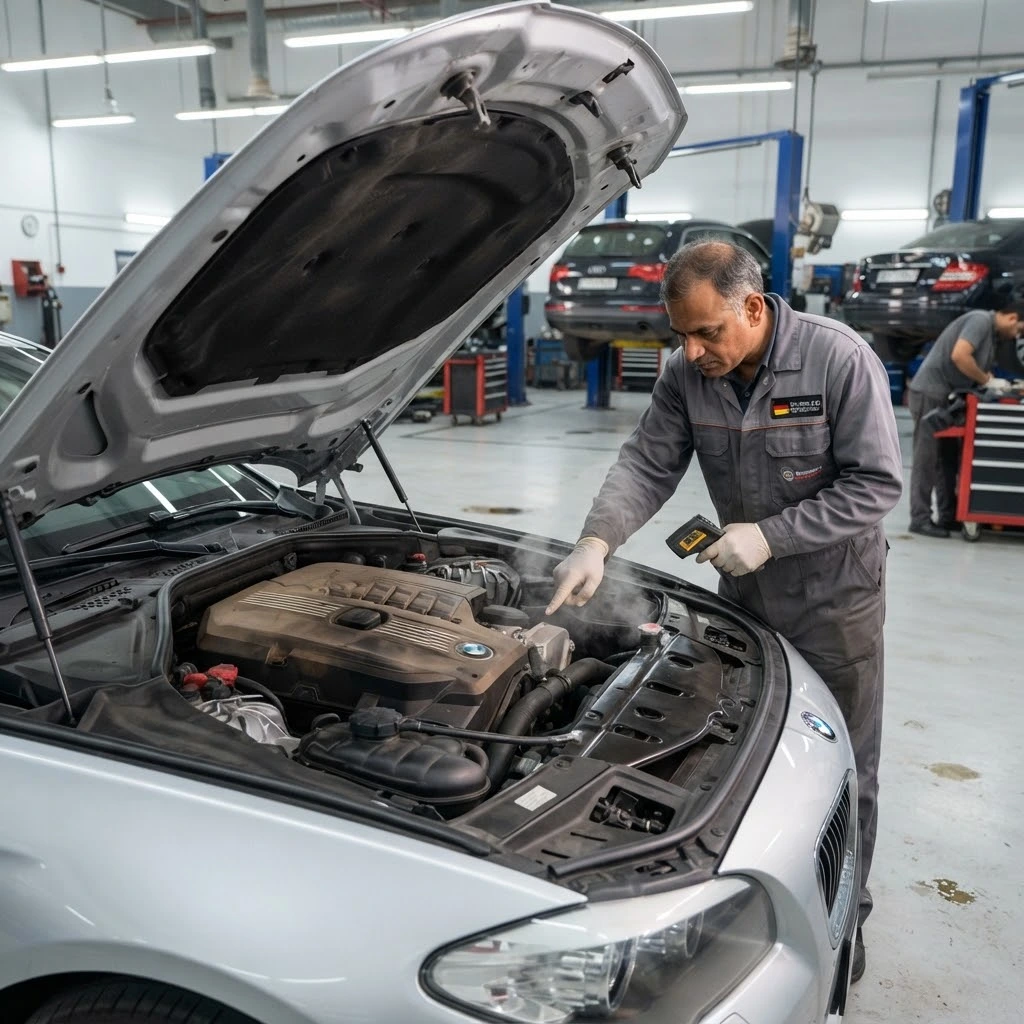
Why cars overheat in Dubai: the eight causes we actually find
Overheating is a symptom, not a fault. On German engines it traces back to a short list, and the pattern of when it overheats usually tells us which one before the car is on the ramp.
1. Electric water pump failure
Most modern German engines run an electrically driven water pump controlled by the ECU instead of a belt-driven one. When the motor or its control module fails there is no squeal and no wobble to warn you — coolant flow simply stops. BMW N20, N26, N55 and B48 engines are the ones we see most, often between 80,000 and 120,000 km in Dubai conditions. Replacement is normally done together with the thermostat.
What you notice: temperature climbs fastest at low speed, reduced power, no visible leak.
2. Thermostat stuck closed
A thermostat jammed shut traps coolant inside the engine while the radiator stays cold to the touch. On Audi and Volkswagen EA888 and EA211 engines the thermostat sits in a plastic housing that also carries the pump, and the housing warps and weeps long before the thermostat itself gives up. Stuck open is the quiet version — the engine never warms properly and a P0128 code appears. Stuck shut takes a car from normal to the red in minutes.
What you notice: rapid climb, top radiator hose cold while the engine is hot.
3. Radiator blocked, split or leaking
Radiators fail two ways here. The plastic end tanks go brittle in the heat and split along the crimped seam, which shows as a slow loss and white or pink residue under the front of the car. The second way is airflow: fine dust packs the radiator core and the air conditioning condenser in front of it, so the system cannot shed heat even though every part is technically working. We clean and pressure test before condemning anything.
What you notice: gradual coolant loss, or overheating that worsens through the summer.
4. Cooling fan not running
If the temperature is fine on the motorway and climbs the moment you sit in traffic, suspect the fan before anything else. Without road speed forcing air through the core, the electric fan is the entire cooling system. The usual culprits are the fan control module, the motor itself, or a failed output stage that leaves the fan stuck at one speed. We compare the commanded fan duty cycle against actual fan speed on the diagnostic tool.
What you notice: normal at speed, climbing in Sheikh Zayed Road traffic with the AC on.
5. Cracked expansion tank or a weak cap
A cooling system only works because it is pressurised, which lifts the boiling point well above 120°C. Lose that pressure and the coolant boils at a temperature the engine reaches every afternoon. Mercedes expansion tanks are the classic case: the plastic goes chalky and cracks around the seam or the level sensor boss. A tired cap seal does the same thing more quietly. It is a cheap fix that prevents an expensive one.
What you notice: white crust around the tank neck, sweet smell after a drive.
6. Head gasket failure
This is usually the result of overheating rather than the cause of it. Once the gasket goes, combustion gases are forced into the coolant: the expansion tank bubbles at idle, the level rises and falls, and the car overheats within minutes of a cold start. Other signs are white steam from the exhaust that never clears and a pale emulsion under the oil cap. A combustion-gas test on the tank confirms it without stripping anything.
What you notice: bubbling in the tank, coolant disappearing with no puddle.
7. Low coolant from a slow leak
Half a litre low is enough to overheat in a Dubai summer. The leaks we find most are the water pump weep hole, hose clamps that have relaxed through heat cycling, the radiator seam, and the heater core — which shows as fogging inside the windscreen and a sweet smell from the vents. Heat evaporates the evidence quickly, so we pressure test the system cold and use UV dye when the leak is intermittent.
What you notice: low level warning every few weeks, no obvious puddle.
8. Air lock after a coolant change
German cooling systems are not designed to be filled by pouring coolant into the tank. If the system has been opened recently and the gauge now spikes then drops, or the heater blows cold while the engine reads hot, there is air trapped in the circuit. The pocket sits against the temperature sensor and around the thermostat, so the readings make no sense. The fix is a proper vacuum fill and bleed, not more coolant.
What you notice: erratic gauge, cold heater, gurgling behind the dashboard.